Showing posts with label SLAMS 2020. Show all posts

Sunday, November 15, 2020

Higher And Higher, past radio waves and visible light

I still remember my first 23cm transverter and my fear from frequencies above 1 GHz. What am I going to do? How am I supposed to measure, even how to tune anything on these high frequencies? It's not that long ago, about 15 years. Of course we managed that frequency. We also managed 10 GHz, later even 24 GHz. I have bought my 47GHz transverter from DB6NT. Now, these wonderful units from VK put us on 122 GHz ...

Harry WA0CNS and Herbert AF4JF made several short QSOs on 122GHz before making our 5.25 km contact on November 7th. See the posting here (click).
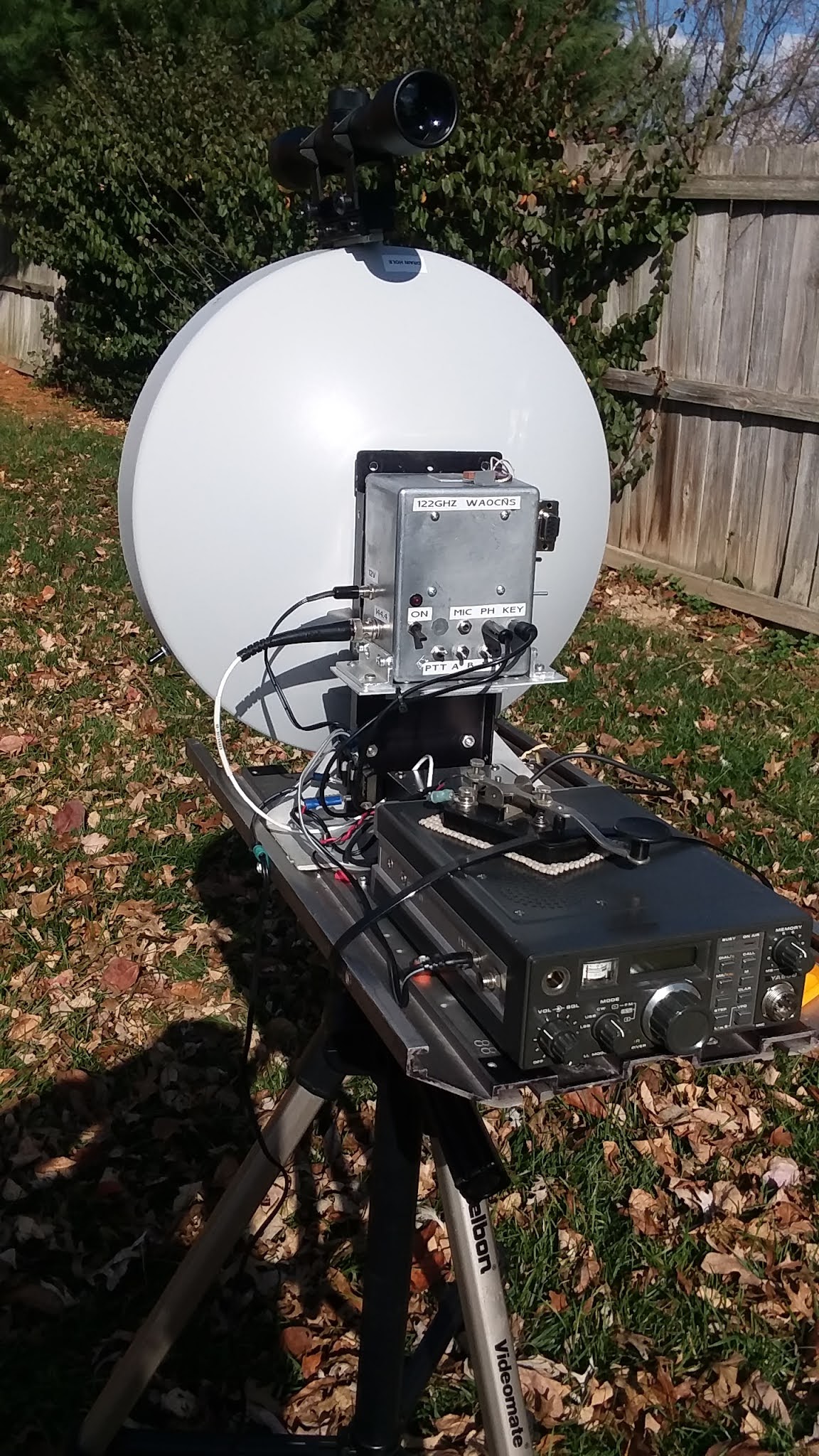


We have been playing with optical communications in the early days of the SLAMS group, see pictures here (click). The BARS group was also planning on some optical communications here (click), but we have never made a full bi-directional QSO until today (click here). Harry WA0CNS and Herbert AF4JF used the opportunity and tested their old equipment while waiting for other participants of the team meeting that we started holding in the Creve Coeur Memorial Park again. Witnessed by Ron KO0Z, our first QSO using red light took place. Harry used his station with two Fresnel lenses, TX with red LED diode wavelength 635 nm and RX with photo diode BPW34. Herbert used his old 5 mW red laser module wavelength 650 nm and a solar panel (!!) from old garden light as RX. No additional lenses used on Herbert's side. First QSO was difficult, especially aiming the stations at each other. We clearly have some work to do here, similar to our experience with 122GHz mentioned above. Using rifle scopes on these frequencies is a MUST!


Harry was actually using voice audio on transmit. That was surprisingly clear and easy to understand on Herbert's side. Herbert responded with 30% AM modulated CW (using shunt modulator).

Harry also built an optical beacon with infrared diodes (the little box on a smaller tripod on the right picture above). These diodes have lenses built in and the beam width is about 5 degrees. Built-in processor transmits beacon patterns and some text with Harry's callsign. I will try to record it and post the recording here next time.

So, what is next? Definitely attempt on longer distances on both, 122 GHz and 462 THz. We will keep working on mechanical stability, improving precise aiming and get more ready for next year.

73 Herbert
AF4JF

Monday, September 21, 2020

Many things happened in September

The SLAMS/BARS group was unusually active in September. Here are the events that took place and links to postings on the SLAMS page (click on the links for more details):


SLAMS September 2020 Breakfast

Sunday, September 6th, Mel K0PFX, Harry WA0CNS, Herbert AF4JF, Armand KD0PFX, Ron KO0Z, Debbie KC9ULA convened at Creve Coeur Park at 9:00 am to test out some gear.  Mike N0OBI came by, but somehow we missed each other.  COVID-19 is still among us, so we met outdoors, wore masks and kept socially distant.


WB9PNU Beacon back on the air

After several months of being off the air, the WB9PNU 10 GHz beacon is once again up and operating from DePaul Hospital in Bridgeton, MO EM48ss thanks to the hard work and dedication of Mel K0PFX and John WB9PNU.  The beacon was thoroughly checked out by Mel and the slot antenna mount was replaced with a stronger mount and the assembly put into a water proof container. 

The beacon operates at 10.368.900 with an AFSK CW telemetry.  The telemetry data is no longer accurate because of control voltage issues.  That will be a future project to re-calibrate the telemetry.


September 2020 Tropo Opening

Tuesday evening, September 15 around 7:25 pm (September 16,00:25 Z), we set up our 10 GHz stations to attempt a 10 GHz QSO with Gedas W8BYA in northern Indiana EN70jt and with Russ KB8U in EN71sw. We didn't make any QSO, but we heard each other with Gedas. Click on the link to know more.


ARRL 10 GHz And Up Contest - September 2020

COVID-19, busy work schedules, grandchildren, moving QTH locations all combined took its toll on this year's SLAMS efforts to be radio active for the ARRL 10 GHz and Up contest.  Still, it's hard to keep uW hams away from a contest and Harry WA0CNS, Herbert AF4JF and Ron KO0Z put in a day's worth of activity on Sunday, September 20, 2020.  We weren't trying to break any records.  Instead, we wanted to try 122 GHz and get some activity on the air.  Herbert and Harry tried to work Gedas W8BYA in Indiana, but the path just wasn't there.  KO0Z didn't even try.  His path to Gedas would involve shooting into a thick forest.


ARRL 10 GHz And Up 2020 as seen by AF4JF

The short contest attempt as seen by AF4JF.


Sunday, June 14, 2020

ARRL VHF June Contest 2020

It has been a while since I have obtained a new SDR (Software Defined Radio) Unit made by Analog Devices, called "ADALM PLUTO".


This is actually a learning module, capable of operation in a frequency range (after a simple hack) from 70MHz to 6GHz. There are several software programs able to work with PLUTO, I am using the SDR Console (note that this software does both, receive and transmit).


I am usually operating from outdoor locations, sometimes as a "rover". That brings a big challenge - how to squeeze everything inside one car? I have used this year's ARRL VHF June Contest to test my idea of using the PLUTO with simple wide band amplifiers and antenna for multi-band operation.

The antenna used for this VHF contest was a logarithmic-periodic PCB antenna made by Kent WA5VJB.


This antenna gives me access to all HAM bands between 900MHz and 6GHz. During this test, I have concentrated on 1296 MHz, 2304 MHz and 3456 MHz. I have also used the PLUTO on 222 MHz, but that was a different antenna.

I have obtained a cheap RX preamp from eBay (35dB gain / 2.5dB noise). I know this is not the greatest, but is was cheap, quick and simple.


The TX exciter (used as a PA capable of up to 100mW here) with GALI84 was from eBay too.


Along with these modules, I also used RX-TX Relay (cheap version on W1GHZ board) and USB-controlled relay board to switch the antenna relay and power for RX or TX amplifiers.

During the contest, I made 14 QSOs during its first 2 hours - 8 of them using the PLUTO. Distance covered by these QSOs was around 4.6 km, the station worked was Harry WA0CNS. However, we have made a test with Zack W9SZ one week before the contest (see here) and made a contact on 2.3 GHz SSB over 24.3 km with good signal.

I believe that the PLUTO is a good way how to improve VHF and microwave activity on HAM bands. I will work on improvements and post them here after next contest.

As for the lower bands, I have used FT857D and ring antennas installed on my car. The multiband microwave antenna was inside the car on the dashboard.


Harry WA0CNS used his home made transverters and antennas on azimuth rotor installed on his car.


My dog Darcey (on last picture) supervised the activity and made sure we followed the contest rules :-)

73 Herbert
AF4JF